
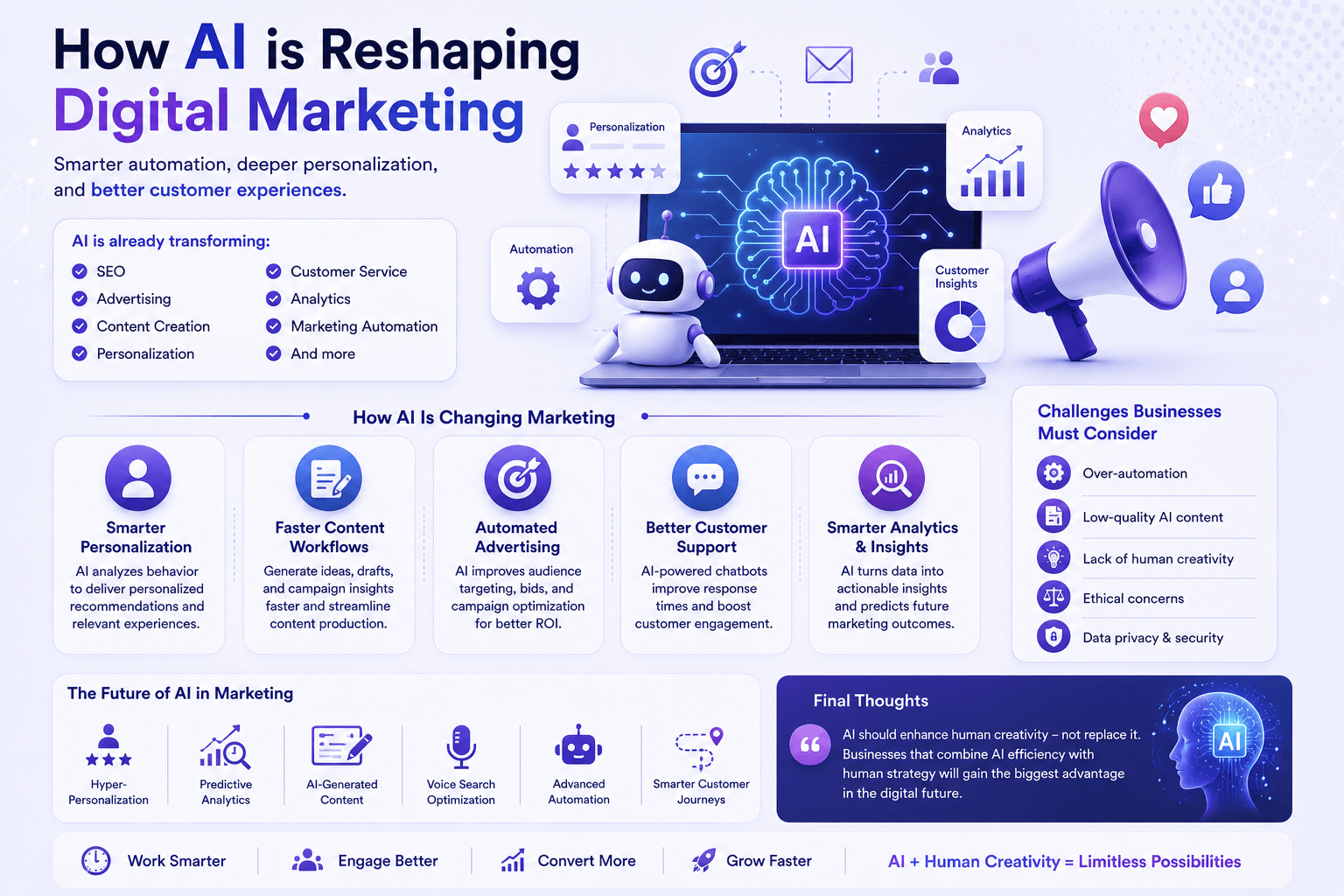
Artificial Intelligence is no longer a futuristic concept reserved for large tech companies.
Today, AI has become a major driving force behind modern digital marketing strategies across industries.
From personalized recommendations and intelligent automation to predictive analytics and customer engagement, AI is helping businesses operate faster, smarter, and more efficiently than ever before.
Modern marketers are now using AI to improve:
- SEO performance
- content creation
- advertising optimization
- audience targeting
- customer support
- marketing automation
- data analysis
- personalization strategies
As consumer expectations continue to evolve, businesses that fail to adopt AI-driven marketing strategies may struggle to stay competitive in the digital landscape.
The Growing Role of AI in Digital Marketing
Digital marketing generates enormous amounts of data every day.
Analyzing customer behavior, tracking campaigns, optimizing ads, and understanding audience intent manually can become extremely time-consuming.
AI helps businesses process this data quickly and make smarter marketing decisions in real time.
Instead of relying solely on guesswork, businesses can now use AI-powered tools to:
- identify customer behavior patterns
- predict buying intent
- automate repetitive tasks
- optimize campaigns faster
- improve customer experiences
- generate marketing insights
This allows marketing teams to focus more on strategy, creativity, and business growth.
Smarter Personalization
One of the biggest advantages of AI in marketing is advanced personalization.
Consumers today expect personalized experiences across websites, emails, advertisements, and social media platforms. AI helps businesses analyze user behavior and deliver highly relevant content based on individual interests and interactions.
AI can track:
- browsing behavior
- purchase history
- search intent
- engagement patterns
- demographic data
- customer preferences
This helps businesses create personalized:
- product recommendations
- email campaigns
- landing pages
- advertisements
- website experiences
Platforms like Netflix, Amazon, Spotify, and YouTube heavily rely on AI-driven personalization to improve user engagement and retention.
For businesses, better personalization often leads to:
- higher engagement
- improved customer satisfaction
- stronger brand loyalty
- better conversion rates
Faster Content Creation & Marketing Workflows
AI is also transforming how businesses approach content marketing.
Modern AI tools can help marketers generate:
- blog topic ideas
- social media captions
- email drafts
- ad copies
- keyword suggestions
- SEO recommendations
- campaign concepts
This significantly reduces the time required for content planning and execution.
Instead of starting from scratch, marketing teams can use AI to accelerate workflows and focus more on refining strategy and creativity.
However, businesses should avoid relying entirely on AI-generated content without human review.
Human creativity, storytelling, emotional connection, and brand voice still play a major role in successful content marketing.
The most effective approach is combining:
AI efficiency + Human creativity
AI-Powered Advertising Optimization
Digital advertising has become far more intelligent because of AI.
Platforms like Google Ads and Meta Ads already use machine learning algorithms to optimize campaigns automatically.
AI can help advertisers by:
- identifying high-performing audiences
- improving ad targeting
- optimizing bidding strategies
- predicting conversion behavior
- reducing wasted ad spend
- improving campaign performance
Instead of manually adjusting campaigns every hour, businesses can now use AI-driven automation to improve efficiency and maximize ROI.
AI-powered advertising also enables:
- dynamic ad personalization
- automated A/B testing
- predictive audience segmentation
- smart budget allocation
This allows businesses to run more data-driven and cost-effective campaigns.
Better Customer Support Through AI
Customer experience has become a critical factor in digital marketing success.
AI-powered chatbots and virtual assistants are helping businesses improve customer support by offering faster and more consistent responses.
Modern AI chatbots can:
- answer common customer queries
- provide product recommendations
- assist with bookings/orders
- handle basic troubleshooting
- guide users through websites
- support lead generation
This improves response times while reducing operational workload for support teams.
AI customer support systems are especially valuable for businesses that receive large volumes of inquiries daily.
However, human support still remains important for complex conversations and relationship-building.
AI in SEO & Search Optimization
AI is also reshaping the SEO industry.
Search engines are becoming more intelligent in understanding:
- user intent
- search context
- content quality
- semantic relevance
- user experience
Modern SEO strategies now require businesses to focus more on:
- high-quality content
- topical authority
- user engagement
- technical SEO
- search intent optimization
AI-powered SEO tools can help businesses with:
- keyword research
- competitor analysis
- technical audits
- content optimization
- search trend analysis
- internal linking suggestions
As search algorithms continue evolving, businesses need smarter SEO strategies supported by both AI tools and human expertise.
Marketing Automation & Efficiency
AI is helping businesses automate repetitive marketing tasks more efficiently.
Automation allows businesses to:
- schedule campaigns
- automate email workflows
- nurture leads
- segment audiences
- track customer journeys
- manage CRM interactions
This improves operational efficiency and helps businesses scale marketing efforts more effectively.
AI-powered automation also reduces manual workload, allowing teams to focus more on strategic decision-making.
Challenges Businesses Must Consider
Despite its advantages, AI also comes with several challenges and risks.
Businesses should be careful about:
Over-Automation
Excessive automation can make marketing feel robotic and impersonal.
Low-Quality AI Content
Poorly generated AI content can harm brand credibility and SEO performance.
Lack of Human Creativity
AI lacks emotional intelligence, creativity, and authentic storytelling.
Ethical & Privacy Concerns
Businesses must handle customer data responsibly and maintain transparency.
Dependence on AI Tools
Over-reliance on automation can reduce strategic thinking and originality.
AI should support human marketers — not completely replace them.
The Future of AI in Digital Marketing
AI will continue becoming more integrated into digital marketing strategies over the next few years.
Future trends may include:
- hyper-personalized experiences
- predictive customer behavior analysis
- AI-generated video content
- voice search optimization
- smarter automation systems
- advanced conversational AI
- AI-driven customer journey mapping
Businesses that adapt early and use AI strategically will likely gain a significant competitive advantage.
Final Thoughts
Artificial Intelligence is reshaping digital marketing at an incredible pace.
From automation and personalization to analytics and customer engagement, AI is helping businesses build smarter and more scalable marketing systems.
However, the most successful brands will not be the ones that rely entirely on AI.
They will be the businesses that combine:
- AI-driven efficiency
with - human creativity, strategy, and emotional connection
In the modern digital landscape, AI is not replacing marketers — it is empowering them to work smarter and deliver better customer experiences.