
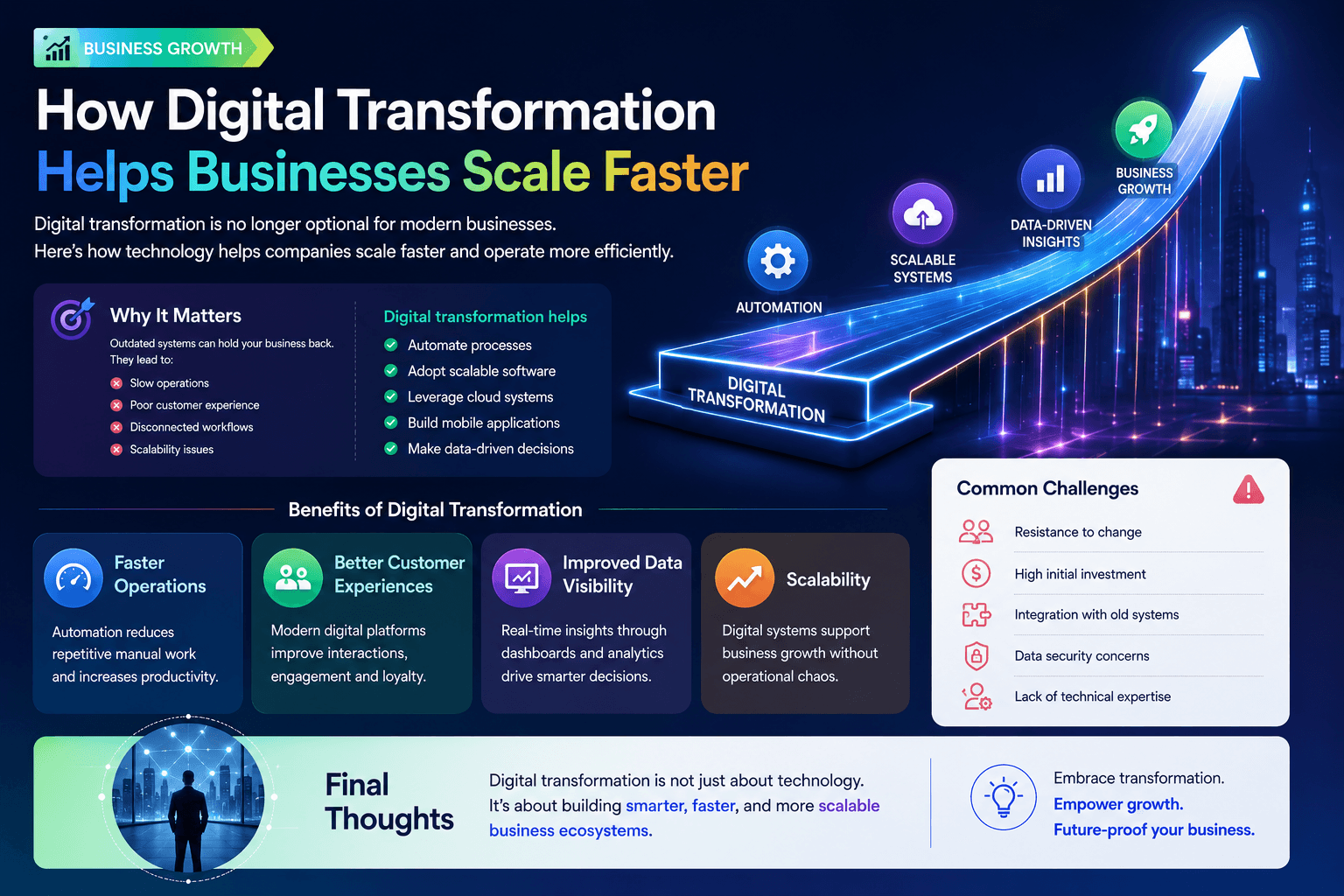
How Digital Transformation Helps Businesses Scale Faster
Introduction
Businesses today operate in highly competitive and rapidly evolving digital environments.
Customer expectations are increasing, competition is becoming more aggressive, and operational efficiency has become essential for long-term growth.
Companies that continue relying on outdated systems, manual processes, and disconnected workflows often struggle with:
- slow operations
- poor customer experiences
- communication gaps
- inefficient workflows
- data management issues
- scalability limitations
As businesses grow, these operational inefficiencies become even more difficult to manage.
Digital transformation helps businesses modernize their operations using technology-driven solutions that improve efficiency, scalability, and decision-making.
Modern digital transformation strategies often include:
- automation systems
- scalable software solutions
- cloud infrastructure
- CRM platforms
- mobile applications
- workflow management tools
- analytics dashboards
- AI-powered systems
Businesses that successfully embrace digital transformation are often able to scale faster, reduce operational bottlenecks, and improve customer satisfaction more effectively.
What is Digital Transformation?
Digital transformation refers to the process of integrating digital technologies into various areas of a business to improve operations, customer experiences, and overall efficiency.
It is not simply about adopting new software.
It involves rethinking how businesses operate, communicate, manage workflows, and deliver value to customers using modern technology.
Digital transformation can impact:
- internal operations
- customer service
- marketing strategies
- sales processes
- communication systems
- reporting structures
- business automation
- data management
The goal is to create smarter, faster, and more scalable business ecosystems.
Why Digital Transformation Matters Today
Modern consumers expect businesses to provide:
- faster services
- seamless digital experiences
- real-time communication
- personalized interactions
- easy accessibility
Businesses that fail to adapt often struggle to remain competitive.
Traditional manual systems can slow down growth because they often create:
- repetitive workloads
- human errors
- delayed communication
- inefficient collaboration
- limited scalability
Digital transformation helps businesses become more agile and responsive in changing market conditions.
Benefits of Digital Transformation
Faster Operations Through Automation
Automation is one of the biggest advantages of digital transformation.
Many businesses still spend large amounts of time handling repetitive manual tasks such as:
- data entry
- report generation
- customer follow-ups
- invoicing
- inventory updates
- workflow approvals
Automation tools help reduce manual effort and improve operational efficiency.
This allows teams to focus more on:
- strategy
- customer relationships
- innovation
- business growth
Faster workflows often lead to:
- improved productivity
- reduced operational costs
- fewer human errors
- quicker response times
Businesses that automate efficiently can scale operations much faster.
Better Customer Experiences
Customer experience has become a major factor in business success.
Modern digital platforms help businesses create smoother and more personalized customer journeys.
Digital transformation improves customer interactions through:
- mobile-friendly platforms
- faster support systems
- self-service portals
- AI-powered chatbots
- CRM integration
- personalized communication
Customers today prefer businesses that offer convenience, speed, and accessibility.
A better digital experience often leads to:
- stronger customer satisfaction
- improved retention
- better brand reputation
- higher conversion rates
Businesses that prioritize customer experience usually gain a significant competitive advantage.
Improved Data Visibility & Decision-Making
Modern businesses generate massive amounts of data every day.
Without proper systems, managing and understanding this data becomes difficult.
Digital transformation enables businesses to use dashboards, analytics platforms, and reporting tools to gain real-time insights into operations.
Businesses can monitor:
- sales performance
- customer behavior
- operational efficiency
- marketing performance
- financial data
- employee productivity
Data-driven insights help companies make smarter and faster decisions.
Instead of relying on assumptions, businesses can identify trends, measure performance, and optimize strategies more effectively.
Better Collaboration & Workflow Management
Disconnected departments and poor communication often create operational inefficiencies.
Digital tools help businesses improve collaboration through:
- centralized systems
- project management platforms
- cloud-based communication
- workflow automation
- shared dashboards
Teams can work more efficiently even when operating remotely or across multiple locations.
Improved collaboration helps businesses:
- reduce delays
- improve transparency
- manage projects better
- increase productivity
- streamline operations
Efficient communication becomes increasingly important as businesses grow.
Scalability Without Operational Chaos
One of the biggest challenges growing businesses face is scalability.
As operations expand, outdated systems often struggle to handle increasing workloads.
Digital transformation allows businesses to scale more efficiently by using systems designed for growth.
Scalable digital systems help businesses manage:
- higher customer volumes
- larger datasets
- increased operational demands
- multiple business locations
- growing teams
Cloud-based platforms and scalable software solutions allow businesses to expand without constantly rebuilding operational structures.
This creates smoother long-term growth.
The Role of Cloud Technology in Business Growth
Cloud systems have become a major part of digital transformation.
Cloud technology helps businesses:
- access data remotely
- improve flexibility
- reduce infrastructure costs
- improve security
- support remote collaboration
Businesses no longer need to rely heavily on physical servers or location-dependent systems.
Cloud-based infrastructure also allows faster scalability and easier system management.
Mobile Apps & Digital Accessibility
Mobile usage continues to grow globally.
Businesses that invest in mobile-friendly platforms and applications often improve customer engagement significantly.
Mobile apps help businesses provide:
- easier accessibility
- faster communication
- personalized notifications
- smoother transactions
- improved customer convenience
Digital accessibility has become a critical factor in modern customer experiences.
Common Challenges During Digital Transformation
Although digital transformation offers many advantages, businesses may also face certain challenges during implementation.
Resistance to Change
Employees and teams may initially struggle to adapt to new systems and workflows.
Poor Planning
Without proper strategy, digital transformation projects can become inefficient or costly.
Integration Issues
Businesses often face challenges connecting older systems with modern technologies.
Data Security Concerns
As businesses become more digital, cybersecurity and data protection become increasingly important.
Lack of Technical Expertise
Some businesses may require external technology partners or consultants to implement digital transformation successfully.
Digital Transformation is More Than Technology
Many businesses mistakenly believe digital transformation is only about purchasing software.
In reality, successful digital transformation requires:
- strategic planning
- process optimization
- customer-focused thinking
- team collaboration
- long-term scalability planning
Technology should support business goals — not complicate them.
The most successful digital transformation strategies focus equally on:
- people
- processes
- technology
The Future of Digital Transformation
Digital transformation will continue evolving as technologies such as:
- Artificial Intelligence
- automation
- cloud computing
- IoT
- data analytics
- machine learning
become more integrated into business operations.
Future-focused businesses will increasingly prioritize:
- operational efficiency
- personalized customer experiences
- automation-driven growth
- data-driven strategies
- scalable digital ecosystems
Companies that adapt early will likely scale faster and remain more competitive in evolving markets.
Final Thoughts
Digital transformation is no longer optional for modern businesses.
It has become a critical foundation for growth, efficiency, scalability, and long-term competitiveness.
Businesses that continue relying on outdated systems may struggle with operational bottlenecks, poor customer experiences, and limited scalability.
By embracing digital transformation, businesses can:
- automate operations
- improve customer engagement
- increase productivity
- gain real-time insights
- scale more efficiently
Digital transformation is not simply about adopting new technology.
It is about building smarter, faster, and more scalable business ecosystems that support sustainable long-term growth.