
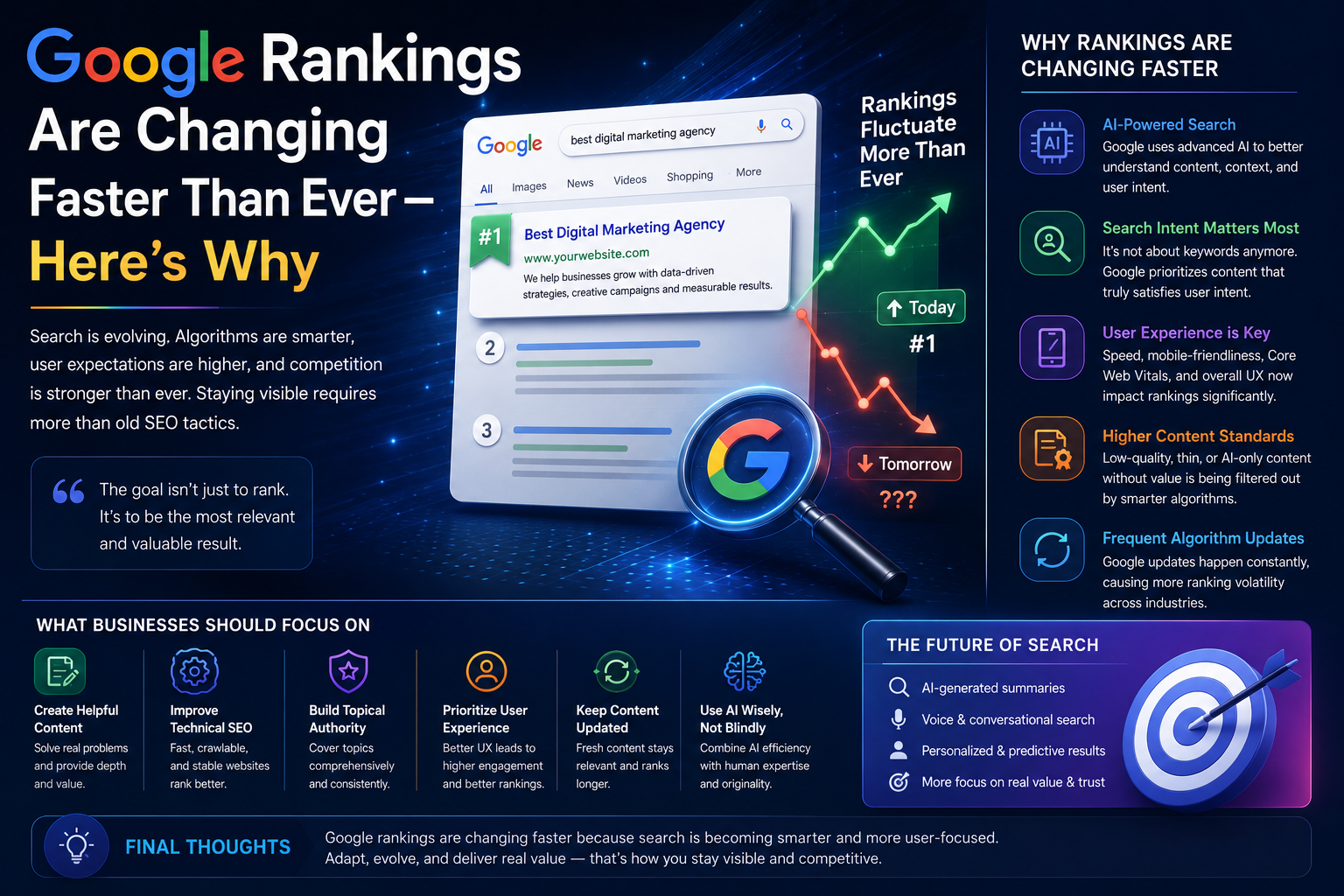
Google’s search rankings are evolving faster than ever before.
Businesses that once ranked successfully using traditional SEO techniques are now experiencing major fluctuations in visibility, traffic, and keyword performance.
The reason is simple:
Google’s algorithms are becoming smarter, more user-focused, and increasingly driven by AI.
Modern SEO is no longer only about:
- keywords
- backlinks
- basic optimization
Today, rankings are heavily influenced by factors such as:
- search intent
- content quality
- user experience
- topical authority
- engagement signals
- technical SEO
- AI-driven search systems
As search behavior continues evolving, businesses must adapt quickly to stay visible in competitive search results.
Why Google Rankings Are Changing So Rapidly
AI is Transforming Search
Artificial Intelligence is playing a much larger role in how Google understands content and user intent.
Google’s AI systems can now better analyze:
- content relevance
- search context
- user behavior
- semantic meaning
- content quality
- expertise and trustworthiness
This means websites can no longer rely on outdated SEO tactics such as keyword stuffing or low-quality content.
Search engines are becoming more focused on delivering the most useful and helpful results to users.
Businesses producing genuine, high-value content are more likely to perform well long-term.
Search Intent Matters More Than Keywords
In the past, simply targeting specific keywords was often enough to rank.
Today, Google prioritizes content that truly satisfies user intent.
Search intent refers to the reason behind a user’s search query.
For example, users searching for:
- “best CRM software”
may expect comparisons and reviews,
while users searching for:
- “how CRM software works”
may expect educational content.
Google now evaluates whether content actually solves user problems instead of simply repeating keywords.
Businesses that understand audience intent usually achieve better engagement and stronger rankings.
User Experience is Now a Major Ranking Factor
Google increasingly rewards websites that provide smooth, fast, and user-friendly experiences.
Factors such as:
- website speed
- mobile responsiveness
- navigation
- Core Web Vitals
- page stability
- accessibility
now significantly influence rankings.
A slow or poorly optimized website can negatively impact:
- user engagement
- bounce rates
- conversions
- search visibility
Even strong content may struggle to rank if the overall website experience is poor.
Content Quality Standards Have Increased
Google’s algorithms are becoming much better at identifying low-quality content.
Generic articles written only for search engines are becoming less effective.
Modern SEO now favors content that demonstrates:
- expertise
- originality
- depth
- credibility
- practical value
- user-focused insights
Businesses publishing thin, repetitive, or AI-generated content without human refinement may experience ranking declines.
High-quality content that genuinely helps users is becoming more important than ever.
The Rise of Topical Authority
Google now values topical authority more heavily than isolated keyword optimization.
Instead of ranking websites based on single pages alone, Google increasingly evaluates how deeply a website covers an entire subject area.
For example, businesses focusing on digital marketing may need comprehensive content covering:
- SEO
- PPC
- social media
- content marketing
- analytics
- technical SEO
- automation
- AI marketing
Websites with strong topical authority are often seen as more trustworthy and valuable.
Frequent Algorithm Updates
Google constantly updates its algorithms throughout the year.
Some updates are minor, while others significantly affect rankings across industries.
Recent algorithm updates have focused heavily on:
- helpful content
- spam reduction
- AI-generated content quality
- user experience
- expertise and trust signals
Because updates occur frequently, rankings may fluctuate more often than businesses expect.
SEO is no longer a one-time activity — it requires continuous monitoring and optimization.
Why Many Businesses Are Losing Rankings
Many businesses still rely on outdated SEO practices that no longer work effectively.
Common SEO mistakes include:
- keyword stuffing
- publishing low-value content
- ignoring technical SEO
- poor mobile optimization
- weak internal linking
- duplicate content
- slow website performance
- buying low-quality backlinks
As Google becomes smarter, these tactics can negatively affect visibility instead of improving it.
The Growing Importance of Technical SEO
Technical SEO now plays a critical role in search visibility.
Search engines need websites that are:
- fast-loading
- mobile-friendly
- easy to crawl
- properly indexed
- technically optimized
Businesses with poor technical infrastructure may struggle even if their content is strong.
Important technical SEO areas include:
- Core Web Vitals
- crawlability
- indexing
- structured data
- site architecture
- page speed optimization
Technical SEO creates the foundation that supports long-term ranking stability.
AI-Generated Search Results Are Changing SEO
Google is increasingly integrating AI-generated search experiences into results pages.
AI-powered search summaries and conversational search experiences are changing how users interact with search engines.
This means businesses may need to optimize not only for rankings, but also for:
- visibility within AI summaries
- conversational queries
- semantic search relevance
- answer-focused content
The future of SEO is becoming more experience-driven and context-focused.
What Businesses Should Focus on Now
To remain competitive in modern search results, businesses should focus on:
Creating Helpful Content
Content should prioritize solving real user problems instead of targeting keywords alone.
Improving Technical SEO
Fast, stable, and mobile-friendly websites perform better in search.
Building Topical Authority
Comprehensive subject coverage improves trust and visibility.
Prioritizing User Experience
Better navigation and engagement signals help improve rankings.
Updating Content Regularly
Fresh and updated content often performs better over time.
Combining AI with Human Expertise
AI tools can improve efficiency, but human insights and strategy remain essential.
The Future of Google Rankings
Search rankings will likely continue evolving rapidly over the next few years.
Future SEO trends may include:
- AI-driven search experiences
- voice search optimization
- predictive search behavior
- hyper-personalized results
- advanced user experience metrics
- conversational search optimization
Businesses that remain adaptable and user-focused will likely perform better long-term.
Final Thoughts
Google rankings are changing faster than ever because search engines are becoming more intelligent, user-focused, and AI-driven.
Traditional SEO tactics alone are no longer enough to maintain strong visibility.
Modern SEO success now depends on:
- high-quality content
- technical performance
- user experience
- topical authority
- search intent optimization
- ongoing adaptability
Businesses that continuously evolve their SEO strategies will be better positioned to maintain rankings and grow organically in the future.
In today’s digital landscape, SEO is no longer just about ranking higher — it is about delivering better experiences and real value to users.