
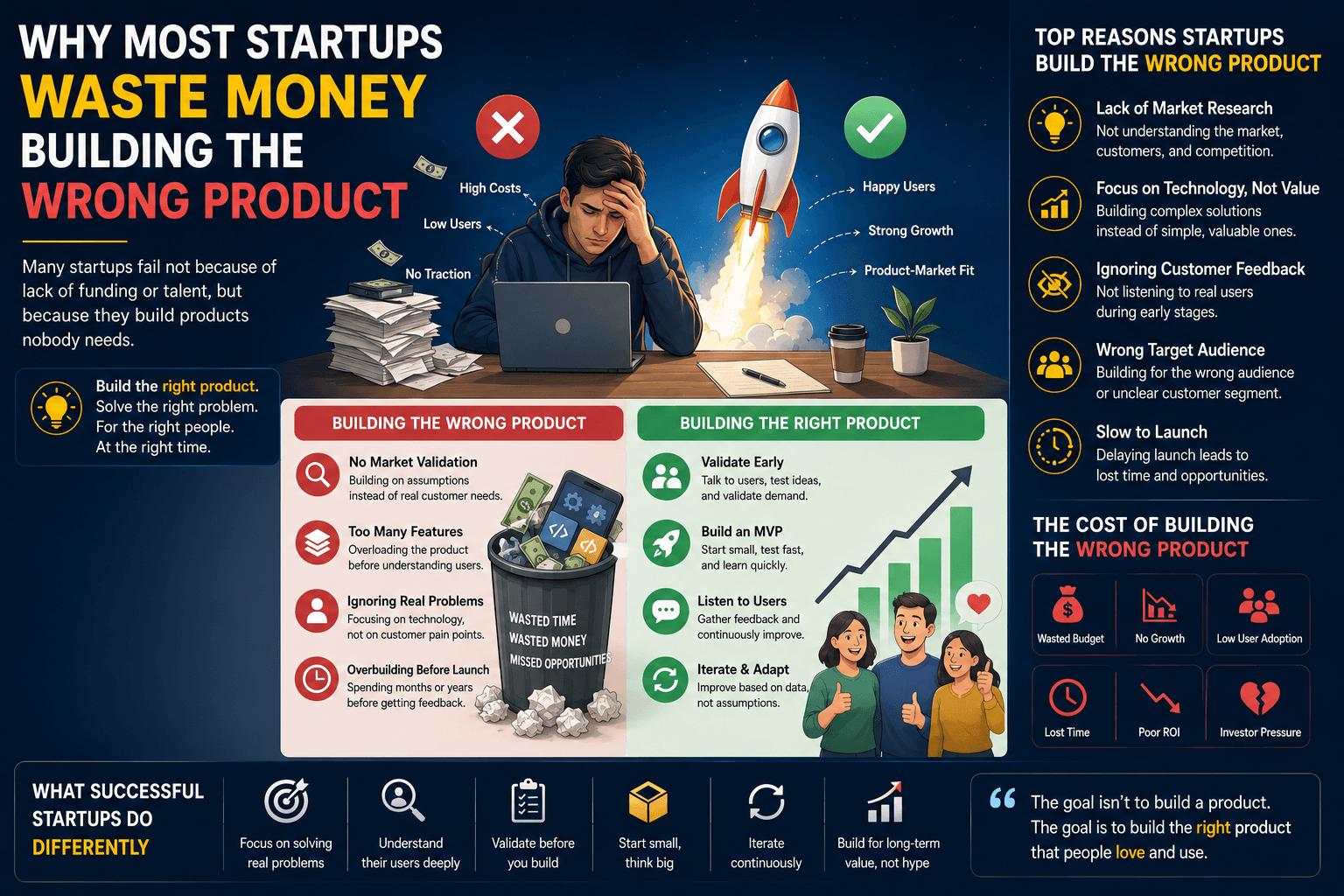
Many startups fail not because they lack funding, talent, or technology — but because they build products that people simply do not need.
One of the biggest mistakes startups make is investing heavily in development before properly validating their idea, market demand, or customer problems.
In the early stages, founders often become emotionally attached to ideas and focus too much on:
- features
- technology
- design
- scalability
while ignoring whether the product actually solves a real problem.
As a result, startups frequently waste time, money, and resources building products that struggle to gain traction.
Modern startups need to focus less on “building fast” and more on “building the right product.”
Why Startups Often Build the Wrong Product
Lack of Market Validation
Many startups begin development based on assumptions instead of real customer research.
Founders may believe an idea is valuable without validating:
- customer pain points
- market demand
- buying intent
- user behavior
- competitor positioning
Without proper validation, businesses risk building solutions nobody actively wants or needs.
Successful startups usually spend time understanding:
- customer frustrations
- industry gaps
- operational inefficiencies
- existing market problems
before investing heavily in development.
Building Too Many Features Too Early
Many startups try to build “everything” from the beginning.
They often overload products with:
- unnecessary features
- complex workflows
- advanced systems
- excessive customization
This increases:
- development costs
- launch delays
- operational complexity
- maintenance challenges
Instead of solving one clear problem effectively, startups end up creating bloated products with unclear value propositions.
The most successful startups usually begin with a focused MVP (Minimum Viable Product).
The Importance of MVP Development
An MVP helps startups test ideas with minimal investment before scaling aggressively.
An MVP focuses only on core functionality required to validate whether users actually want the product.
This approach helps startups:
- reduce development costs
- launch faster
- gather real user feedback
- validate market demand
- improve product-market fit
Building a smaller but validated product is often far more effective than spending large budgets on untested ideas.
Ignoring Real Customer Problems
Many startups focus more on technology than customer pain points.
However, users rarely care about how technically advanced a product is if it does not solve a meaningful problem.
Successful products usually solve problems related to:
- convenience
- efficiency
- cost reduction
- accessibility
- speed
- automation
- user experience
Startups that deeply understand customer frustrations often build stronger products with higher adoption potential.
Poor Market Research & Competitive Analysis
Some startups enter industries without properly understanding competitors or market conditions.
This often leads to products that are:
- too similar to existing solutions
- poorly differentiated
- misaligned with customer expectations
Competitive research helps startups identify:
- market gaps
- underserved audiences
- pricing opportunities
- feature expectations
- positioning strategies
Without proper research, startups may struggle to stand out in crowded markets.
Overbuilding Before Launch
Many founders spend months or years perfecting products before releasing them publicly.
This often creates major risks because:
- customer needs may change
- market conditions may shift
- competitors may move faster
- assumptions may prove wrong
Modern startup environments reward speed, adaptability, and iteration.
Launching earlier allows startups to:
- collect feedback
- improve products faster
- reduce unnecessary spending
- identify weaknesses early
The goal should not be perfection before launch — it should be learning quickly.
Why Customer Feedback Matters
Customer feedback is one of the most valuable assets during product development.
Real users help startups understand:
- what works
- what confuses users
- which features matter most
- where friction exists
- what customers actually value
Startups that actively listen to users are often able to improve products faster and build stronger product-market fit.
Ignoring feedback can result in products that become disconnected from actual market needs.
The Cost of Building the Wrong Product
Building the wrong product can create serious financial and operational consequences.
Startups may experience:
- wasted development budgets
- delayed growth
- investor pressure
- low customer adoption
- poor retention rates
- operational inefficiencies
- branding challenges
In many cases, startups fail not because the idea was completely bad — but because they built the wrong version of the product.
Technology Alone Does Not Guarantee Success
Many founders believe advanced technology automatically creates successful businesses.
However, even highly innovative products can fail without:
- market demand
- clear positioning
- customer understanding
- usability
- proper execution
The best startups focus equally on:
- customer problems
- business strategy
- user experience
- scalability
- technology implementation
Technology should support business goals — not become the entire focus.
Why Agile Development Matters
Agile development allows startups to adapt quickly during product creation.
Instead of building everything upfront, startups can:
- release smaller updates
- test features gradually
- improve based on feedback
- pivot faster when necessary
This reduces the risk of investing heavily into the wrong direction.
Agile product development is especially important in fast-changing digital markets.
Common Startup Product Mistakes
Many startups repeat similar product development mistakes such as:
- skipping market research
- ignoring customer validation
- overbuilding features
- focusing only on technology
- delaying launch too long
- poor user experience design
- weak differentiation
- lack of scalability planning
Avoiding these mistakes can significantly improve startup success rates.
What Successful Startups Do Differently
Successful startups usually focus on:
Solving Real Problems
They build products around genuine customer needs.
Launching Fast
They validate ideas quickly instead of waiting for perfection.
Listening to Users
They continuously improve products based on feedback.
Building Scalable Systems
They plan long-term growth carefully.
Staying Flexible
They adapt strategies when market conditions change.
The Future of Startup Product Development
Modern startups increasingly rely on:
- AI-driven insights
- customer analytics
- rapid prototyping
- automation tools
- agile workflows
- data-driven decision-making
The startups that succeed in the future will likely be those that combine:
- innovation
- customer understanding
- operational efficiency
- strategic execution
instead of simply building large feature-heavy products.
Final Thoughts
Most startups waste money not because they lack ambition — but because they build products without proper validation, strategy, or customer understanding.
The most successful startups focus on:
- solving real problems
- validating ideas early
- building lean MVPs
- listening to users
- improving continuously
In today’s competitive digital landscape, building the right product matters far more than simply building more features.
Startups that prioritize customer needs, adaptability, and strategic product development will have a much stronger chance of long-term success.