
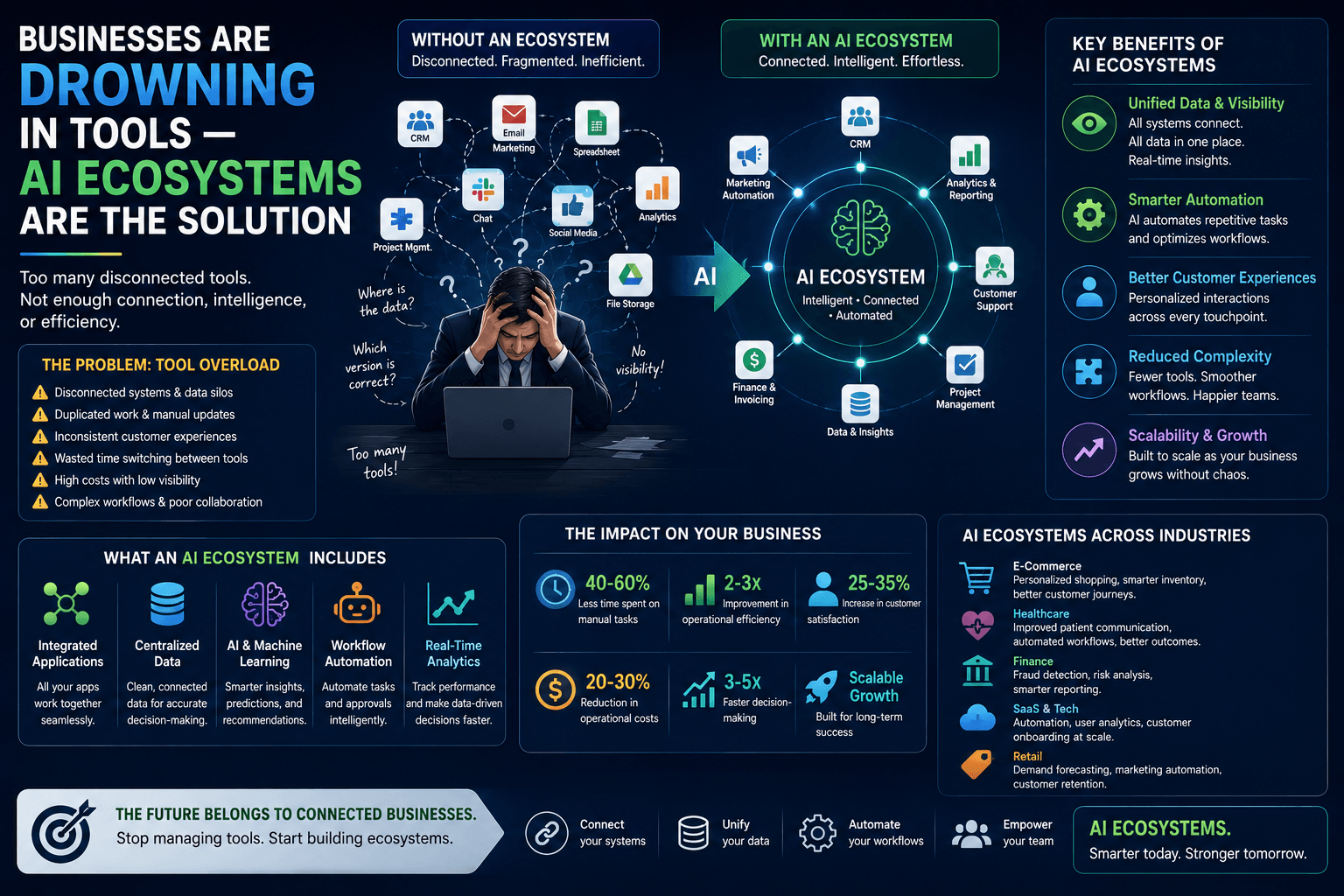
Modern businesses are using more digital tools than ever before.
Companies today rely on multiple platforms for:
- customer management
- marketing automation
- communication
- analytics
- project management
- customer support
- sales tracking
- workflow automation
While these tools are designed to improve efficiency, many businesses are now facing a new problem:
Tool overload.
Instead of creating smoother operations, disconnected software systems often create:
- operational confusion
- fragmented workflows
- data silos
- duplicated work
- communication gaps
- reduced productivity
As businesses continue scaling, managing dozens of isolated tools becomes increasingly difficult.
This is where AI-powered ecosystems are becoming the future of business operations.
Rather than relying on disconnected software, businesses are now moving toward intelligent AI ecosystems where systems, data, automation, and workflows work together seamlessly.
The Growing Problem of Tool Overload
Over the past decade, businesses rapidly adopted software solutions for nearly every operational task.
Today, a single company may use separate platforms for:
- CRM management
- email marketing
- social media scheduling
- project tracking
- invoicing
- analytics
- customer support
- internal communication
- sales automation
While each tool solves a specific problem individually, many businesses struggle because these systems are not properly connected.
This creates operational inefficiencies such as:
- switching between multiple dashboards
- inconsistent reporting
- duplicated data entry
- delayed communication
- disconnected customer information
The more tools businesses add, the more complex operations often become.
Why Traditional Software Stacks No Longer Work Efficiently
Many businesses mistakenly believe adding more software automatically improves productivity.
In reality, disconnected software stacks often create:
- workflow bottlenecks
- operational silos
- employee confusion
- integration challenges
- inconsistent customer experiences
Teams spend significant time managing systems instead of focusing on strategic work.
As businesses grow, this operational complexity increases rapidly.
Traditional software approaches are no longer enough for modern digital scalability.
Businesses now require connected and intelligent ecosystems rather than isolated tools.
What Are AI Ecosystems?
AI ecosystems are integrated digital environments where:
- software systems
- automation tools
- customer data
- analytics platforms
- AI-powered processes
- communication systems
work together intelligently.
Instead of operating separately, systems share information automatically and optimize workflows in real time.
AI ecosystems combine:
- automation
- machine learning
- centralized data
- intelligent decision-making
- workflow integration
to create more efficient business operations.
The goal is not simply to add more technology — it is to create smarter operational infrastructure.
How AI Ecosystems Solve Modern Business Problems
Unified Data & Centralized Visibility
One of the biggest challenges businesses face is fragmented data.
Different departments often operate using separate systems, making it difficult to access accurate real-time insights.
AI ecosystems centralize information across platforms, helping businesses gain visibility into:
- customer behavior
- sales performance
- marketing analytics
- operational efficiency
- workflow performance
This improves decision-making and reduces confusion across teams.
Smarter Automation
AI ecosystems automate repetitive operational tasks across departments.
Instead of manually managing multiple systems, businesses can automate:
- lead nurturing
- customer onboarding
- reporting
- task assignments
- support workflows
- email sequences
- customer segmentation
Automation reduces operational workload while improving speed and efficiency.
Teams can focus more on:
- strategy
- creativity
- customer relationships
- business growth
instead of repetitive administration.
Better Customer Experiences
Customers now expect seamless digital experiences across all touchpoints.
Disconnected tools often create inconsistent customer journeys because systems fail to communicate properly.
AI ecosystems help businesses provide:
- personalized experiences
- faster responses
- consistent communication
- intelligent recommendations
- better customer support
AI-powered systems can analyze customer behavior and improve interactions in real time.
This creates stronger customer engagement and higher satisfaction.
Reduced Operational Complexity
Many businesses are overwhelmed by the complexity of managing multiple platforms.
AI ecosystems simplify operations by connecting systems into one intelligent environment.
Employees spend less time:
- switching platforms
- manually updating information
- resolving workflow issues
- searching for data
This improves operational efficiency significantly.
Improved Scalability
As businesses grow, disconnected systems become increasingly difficult to manage.
AI ecosystems support scalability by creating flexible and connected operational infrastructures.
Businesses can handle:
- larger customer volumes
- growing teams
- increased workflows
- multi-channel operations
- expanding datasets
without constantly rebuilding systems from scratch.
Scalable AI ecosystems help businesses grow more sustainably.
The Role of AI in Connected Ecosystems
Artificial Intelligence makes digital ecosystems more intelligent and adaptive.
AI can help ecosystems through:
- predictive analytics
- intelligent automation
- customer behavior analysis
- workflow optimization
- real-time recommendations
- conversational AI systems
- automated reporting
AI allows systems to continuously improve operational efficiency over time.
This transforms businesses from reactive operations into data-driven organizations.
Why Businesses Need Ecosystem Thinking
Modern businesses can no longer focus only on individual software tools.
Instead, they must think about how systems work together as part of a larger operational ecosystem.
Successful digital ecosystems prioritize:
- integration
- automation
- centralized data
- scalability
- customer experiences
- intelligent workflows
Businesses that continue relying on disconnected software stacks may struggle with increasing operational inefficiencies.
Industries Already Moving Toward AI Ecosystems
Many industries are already adopting AI-powered ecosystems to improve scalability and efficiency.
eCommerce
Integrated systems help manage marketing, inventory, customer journeys, and analytics.
Healthcare
AI ecosystems support patient management, communication, and operational workflows.
SaaS & Technology
Businesses use AI ecosystems for automation, analytics, and customer engagement.
Finance
Connected AI systems improve fraud detection, reporting, and customer experiences.
Retail
AI ecosystems help optimize operations, personalization, and customer retention.
Common Mistakes Businesses Make
Businesses often struggle with digital transformation because they:
- adopt too many disconnected tools
- ignore integration planning
- focus only on software purchases
- overlook scalability
- fail to centralize data
- avoid workflow automation
Technology alone does not create efficiency.
Connected systems and strategic implementation are what create long-term operational value.
The Future of AI Ecosystems
The future of business operations will likely revolve around:
- intelligent automation
- connected cloud systems
- predictive analytics
- AI-powered workflows
- unified customer experiences
- centralized operational intelligence
Businesses that adopt ecosystem-driven approaches early will likely become more agile and competitive.
AI ecosystems will increasingly become the operational backbone of modern digital businesses.
Final Thoughts
Modern businesses are drowning in disconnected tools, fragmented workflows, and operational complexity.
Adding more software alone is no longer the solution.
The future belongs to businesses that build intelligent AI ecosystems where systems, data, automation, and workflows operate together seamlessly.
AI ecosystems help businesses:
- improve efficiency
- automate operations
- reduce complexity
- centralize data
- enhance customer experiences
- scale faster
In the evolving digital landscape, businesses no longer need more tools.
They need smarter, connected, and AI-powered ecosystems that support sustainable long-term growth.