Startups today operate in one of the most competitive digital environments ever.
Users expect:
- fast applications
- seamless performance
- attractive UI
- smooth interactions
- real-time responsiveness
- regular updates
At the same time, startups must also balance:
- limited budgets
- shorter launch timelines
- product validation pressure
- scalability concerns
- investor expectations
This is why choosing the right mobile app framework has become one of the most important technical decisions for modern startups.
Among all available frameworks, Flutter and React Native continue dominating the cross-platform app development ecosystem.
But which framework is actually better for startups in 2026?
The answer depends on multiple factors including:
- product goals
- team expertise
- development speed
- scalability
- UI expectations
- long-term maintenance
Before choosing between Flutter and React Native, businesses need to understand what each framework offers and how it aligns with their product strategy. That’s why cross-platform frameworks like Flutter and React Native have become the preferred choice for modern mobile app development.
But one question continues to dominate startup discussions:
Which framework is better — Flutter or React Native?
The answer depends on your business goals, budget, timeline, performance expectations, and long-term scalability.
What is Flutter?
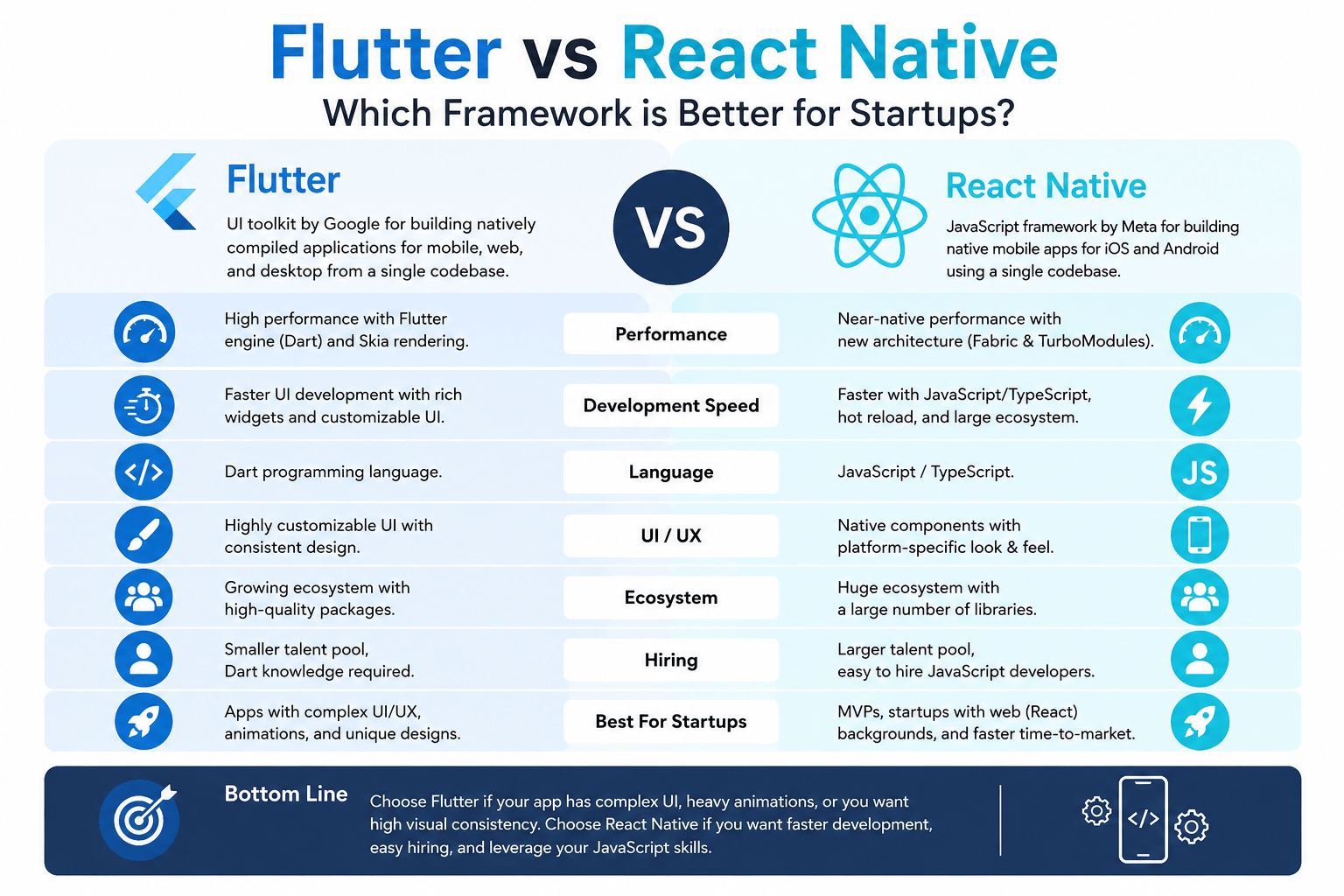
Flutter is Google’s UI toolkit that allows developers to build cross-platform mobile applications using a single codebase.
Key Advantages
- Fast development
- Beautiful UI rendering
- Strong performance
- Single codebase for Android & iOS
- Excellent for custom UI-heavy apps
What is React Native?
React Native is Meta’s cross-platform framework built using JavaScript and React.
Key Advantages
- Large developer community
- Faster hiring availability
- Reusable web development knowledge
- Strong third-party ecosystem
- Faster MVP development
Which is Better for Startups?
Choose Flutter if:
- You need highly customized UI
- App design is a priority
- You want near-native performance
- Long-term scalability matters
Choose React Native if:
- You already use React for web
- You need faster MVP launches
- You want easier developer availability
- Budget optimization is critical
Real-World Startup Considerations
Before selecting a framework, startups should ask:
- How quickly do we need to launch?
- Is UI a major competitive advantage?
- Will the app scale significantly?
- Do we need deep device integrations?
- How important is long-term maintainability?
- What is our development budget?
These questions matter more than simply following trends.
Performance Comparison
Flutter generally provides:
- smoother animations
- better rendering consistency
- near-native performance
- stronger custom UI flexibility
React Native generally provides:
- faster onboarding
- easier developer availability
- better ecosystem maturity
- simpler integration for React-based teams
UI & Design Flexibility
Flutter is particularly strong for:
- custom interfaces
- animation-heavy applications
- visually rich experiences
- consistent UI across platforms
React Native works extremely well for:
- content-based applications
- MVPs
- startup products with limited budgets
- apps requiring faster release cycles
Scalability Considerations
As startups grow, scalability becomes critical.
A poorly planned architecture can create:
- technical debt
- maintenance challenges
- slower updates
- higher operational costs
Both Flutter and React Native can scale successfully when built with proper architecture and experienced development teams.
Final Thoughts
Both frameworks are powerful. The right choice depends on your product vision, scalability goals, user experience expectations, and development strategy.
There is no universal “best framework” — only the framework that best fits your business goals.
At Tech Tide, we help startups evaluate product requirements, technical scalability, user expectations, and long-term growth strategies before selecting the right development framework.
A strong technical foundation today creates faster scalability tomorrow.
At Tech Tide, we help startups choose the right technology stack based on business objectives, not trends.