
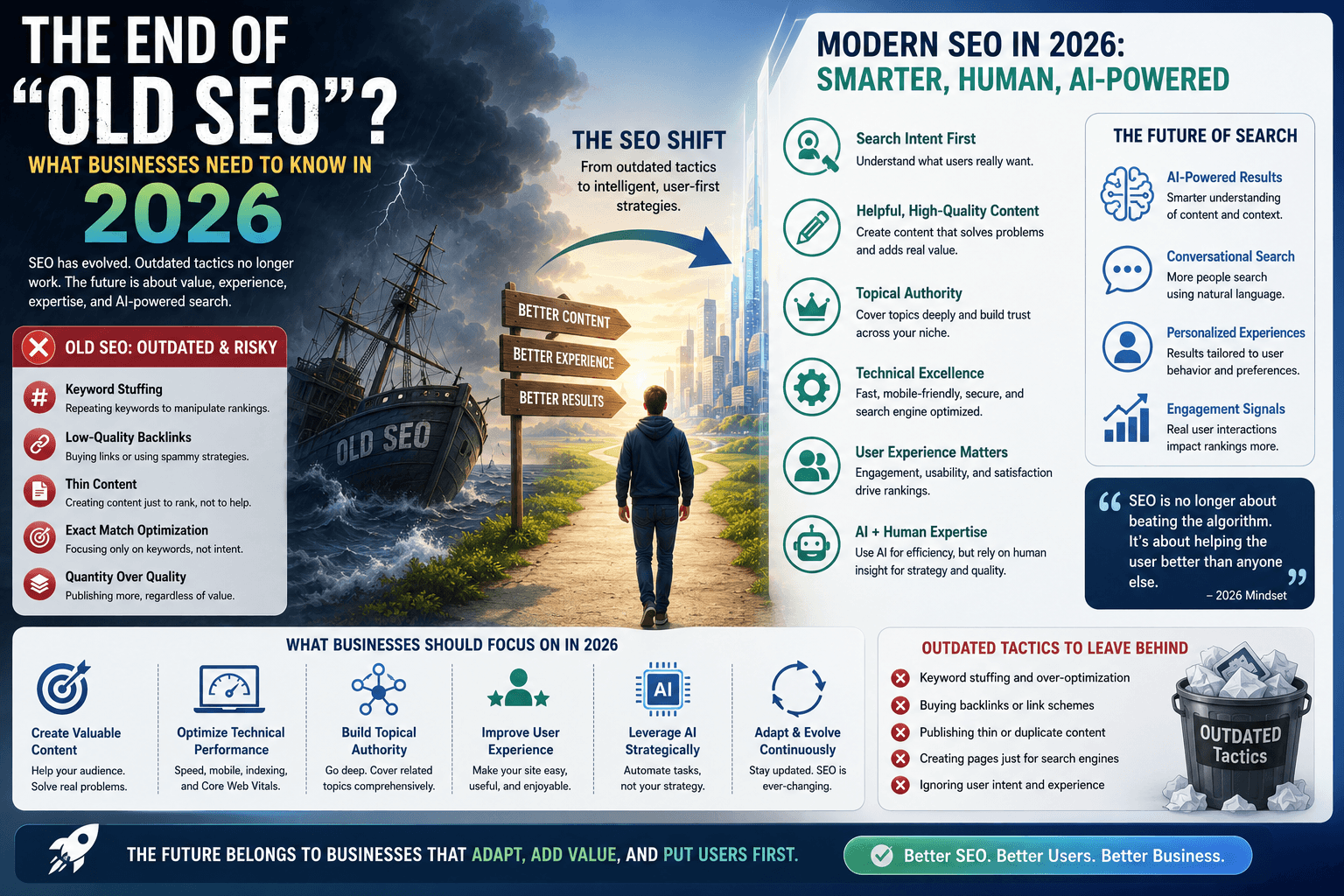
SEO is changing faster than ever before.
Strategies that worked a few years ago are rapidly becoming outdated as search engines evolve through Artificial Intelligence, machine learning, and increasingly sophisticated ranking systems.
For many businesses, traditional SEO methods focused heavily on:
- keyword stuffing
- mass backlink building
- thin blog content
- exact-match optimization
- quantity over quality
However, modern search engines now prioritize:
- user experience
- helpful content
- search intent
- topical authority
- technical performance
- engagement signals
- credibility and trust
This shift is forcing businesses to rethink how they approach SEO in 2026.
The future of SEO is no longer about manipulating algorithms — it is about delivering genuine value and better digital experiences.
What Was “Old SEO”?
Traditional SEO strategies were largely focused on gaming search engine algorithms.
Many businesses tried to rank by:
- repeating keywords excessively
- building low-quality backlinks
- publishing large volumes of thin content
- creating pages only for search engines
- focusing on rankings instead of user experience
While some of these tactics worked years ago, search engines have become significantly smarter.
Google now uses advanced AI systems to better understand:
- content quality
- user behavior
- search context
- expertise
- semantic meaning
- content usefulness
As a result, many outdated SEO strategies are becoming ineffective or even harmful.
Why SEO is Changing So Rapidly
AI is Reshaping Search
Artificial Intelligence is transforming how search engines understand content and rank websites.
Google’s AI systems can now evaluate:
- search intent
- user satisfaction
- topical depth
- content relevance
- engagement patterns
- semantic relationships
Search engines are no longer relying only on exact keywords.
Instead, they focus more on whether content genuinely answers user queries and provides meaningful value.
Businesses that continue relying on outdated optimization techniques may struggle to maintain visibility.
Search Intent Matters More Than Keywords
One of the biggest changes in modern SEO is the growing importance of search intent.
In the past, businesses often focused heavily on ranking for specific keywords.
Today, Google prioritizes content that best satisfies what users actually want.
For example:
A user searching for:
- “best CRM software for startups”
expects comparisons, reviews, and recommendations.
While someone searching:
- “how CRM software works”
expects educational explanations.
Modern SEO requires businesses to deeply understand customer intent rather than simply targeting keywords.
Helpful Content is Becoming Essential
Google increasingly rewards websites that publish:
- original insights
- detailed explanations
- practical solutions
- expert-level information
- trustworthy content
Thin or generic content created purely for rankings is becoming less effective.
Businesses must now focus on creating content that genuinely helps users solve problems or make decisions.
Helpful content improves:
- engagement
- time on page
- trust
- organic visibility
- conversions
The future of SEO belongs to businesses that prioritize value over volume.
Technical SEO is More Important Than Ever
Technical SEO now plays a critical role in rankings.
Even high-quality content may struggle if websites suffer from:
- slow loading speeds
- poor mobile optimization
- crawlability issues
- indexing problems
- weak site architecture
- poor Core Web Vitals
Search engines increasingly prioritize websites that provide smooth and stable user experiences.
Important technical SEO factors in 2026 include:
- mobile-first indexing
- Core Web Vitals
- structured data
- internal linking
- page speed optimization
- secure HTTPS environments
Technical performance creates the foundation for long-term organic growth.
The Rise of Topical Authority
Google now values topical authority more heavily than isolated keyword optimization.
Instead of ranking individual pages alone, search engines increasingly evaluate how deeply a website covers an entire subject area.
For example, a business focused on digital marketing may need comprehensive content around:
- SEO
- PPC
- social media
- AI marketing
- automation
- analytics
- technical SEO
- content strategy
Websites demonstrating expertise across an entire topic area are often considered more trustworthy.
User Experience Directly Impacts SEO
SEO and user experience are now deeply connected.
Search engines increasingly analyze how users interact with websites.
Factors such as:
- bounce rates
- page speed
- navigation
- mobile usability
- readability
- engagement
can influence search performance.
A technically optimized website with poor user experience may still struggle to perform well.
Businesses must now focus on both:
- search engine optimization
and - user satisfaction
simultaneously.
Why Low-Quality AI Content is Risky
AI-powered content tools are becoming more common.
However, businesses that publish large amounts of low-quality AI-generated content without human oversight may face ranking problems.
Search engines are increasingly capable of identifying:
- repetitive content
- shallow information
- low-value pages
- unhelpful AI-generated articles
AI can improve efficiency, but successful SEO still requires:
- human expertise
- strategic thinking
- originality
- real insights
- authentic communication
The future of SEO will likely favor businesses that combine:
AI efficiency + Human expertise
SEO is Becoming More Competitive
As more businesses invest in digital marketing, SEO competition continues increasing across industries.
Ranking successfully now requires stronger focus on:
- content quality
- authority building
- technical optimization
- user engagement
- strategic content planning
Businesses relying on outdated SEO shortcuts may struggle to compete with brands investing in long-term digital strategies.
Voice Search & Conversational Search Are Growing
Search behavior is evolving beyond traditional text-based queries.
Users increasingly interact with search engines through:
- voice assistants
- conversational AI
- mobile search
- AI-generated search experiences
This is changing how businesses optimize content.
Future SEO strategies may increasingly focus on:
- natural language optimization
- conversational queries
- answer-focused content
- semantic search relevance
SEO is becoming more context-driven and user-focused.
What Businesses Should Focus on in 2026
Create Helpful & Valuable Content
Focus on solving real user problems instead of chasing keywords alone.
Improve Technical SEO
Ensure websites are fast, mobile-friendly, crawlable, and technically optimized.
Build Topical Authority
Cover topics deeply and consistently to build trust and expertise.
Prioritize User Experience
Better usability and engagement improve long-term SEO performance.
Use AI Strategically
AI can improve workflows, but human expertise should guide strategy and quality.
Continuously Adapt
SEO is evolving rapidly, and businesses must remain flexible and updated.
The Future of SEO
The future of SEO will likely become increasingly driven by:
- AI-powered search
- personalized search experiences
- semantic understanding
- user engagement signals
- conversational search
- predictive search behavior
Businesses that focus on genuine value, customer experience, and long-term authority will likely perform best in evolving search environments.
Final Thoughts
Old SEO strategies focused heavily on algorithms, keywords, and shortcuts.
Modern SEO is becoming far more intelligent, user-focused, and experience-driven.
Businesses that continue relying on outdated SEO tactics may struggle to maintain rankings as search engines evolve.
The future of SEO in 2026 belongs to businesses that prioritize:
- helpful content
- technical performance
- topical authority
- user experience
- strategic optimization
- authentic value creation
SEO is no longer just about ranking higher.
It is about building trust, solving problems, and delivering better digital experiences for users.