
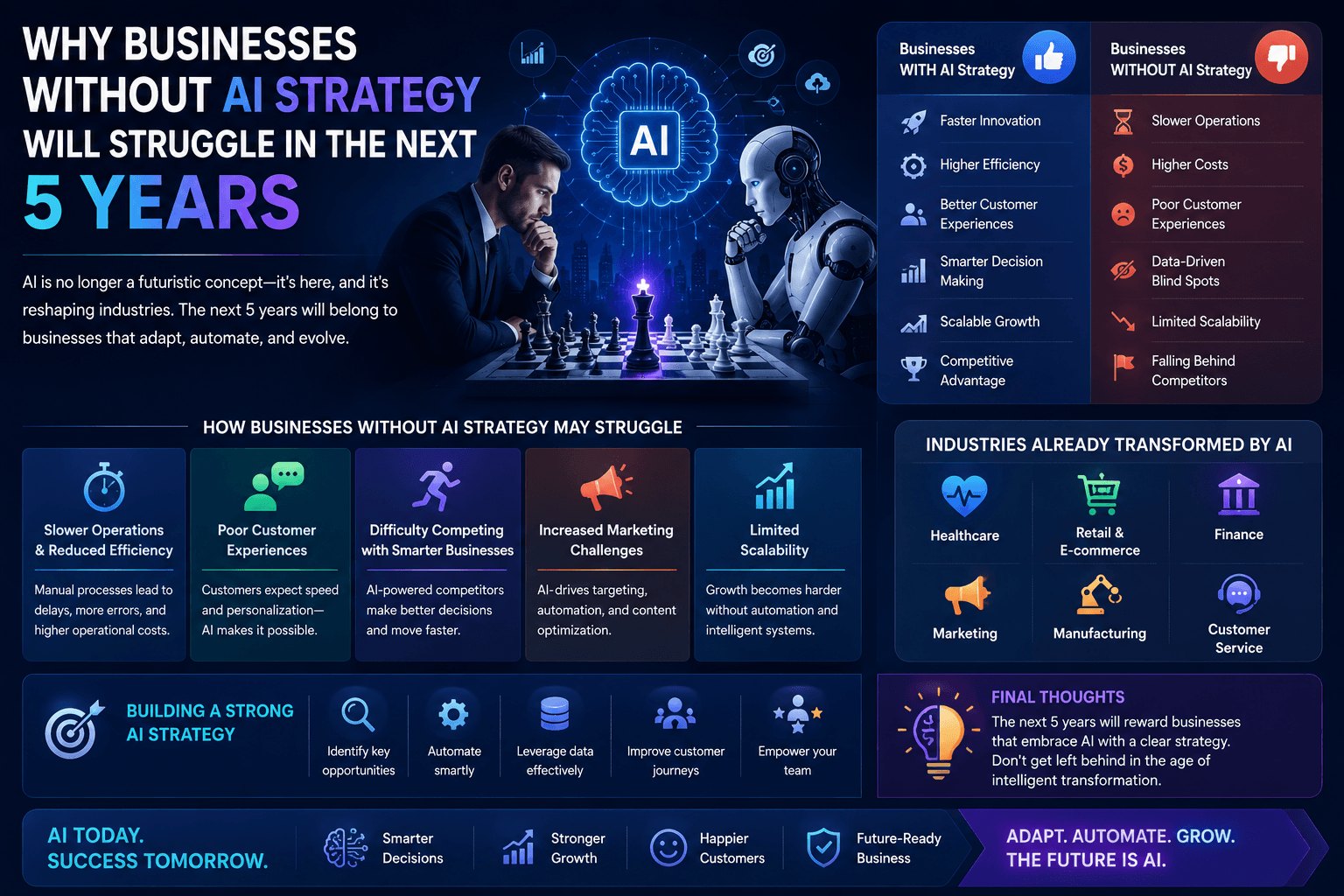
Artificial Intelligence is rapidly transforming how businesses operate, compete, and grow.
What once seemed like futuristic technology has now become a core part of modern business strategy across industries.
From marketing automation and customer support to analytics and operational efficiency, AI is helping businesses make faster decisions, improve productivity, and create smarter customer experiences.
Companies that fail to develop a clear AI strategy over the next few years may struggle with:
- slower operations
- higher costs
- reduced competitiveness
- weaker customer engagement
- inefficient decision-making
- limited scalability
As digital transformation accelerates globally, AI is no longer becoming an optional advantage — it is becoming a business necessity.
What is an AI Strategy?
An AI strategy is a structured plan that defines how a business will use Artificial Intelligence to improve operations, efficiency, customer experiences, and long-term growth.
An effective AI strategy helps businesses identify:
- where automation can improve workflows
- how AI can improve customer engagement
- which processes can become more data-driven
- how technology can support scalability
- where AI creates competitive advantages
Businesses without a clear AI direction may struggle to adapt as industries become increasingly technology-driven.
Why AI is Becoming Essential for Modern Businesses
Consumer behavior and market expectations are changing rapidly.
Modern customers expect:
- faster responses
- personalized experiences
- smarter recommendations
- instant accessibility
- seamless digital interactions
Businesses that rely entirely on manual processes often struggle to meet these expectations efficiently.
AI helps companies become:
- faster
- smarter
- more scalable
- more responsive
- more competitive
Over the next five years, AI adoption will likely become one of the biggest differentiators between growing businesses and struggling businesses.
How Businesses Without AI Strategy May Struggle
Slower Operations & Reduced Efficiency
Businesses that continue relying heavily on manual processes may experience slower operations compared to competitors using AI-powered automation.
AI can automate repetitive tasks such as:
- customer support
- data processing
- reporting
- lead management
- workflow approvals
- scheduling
- content generation
Without automation, businesses often face:
- increased operational workload
- slower response times
- higher human error rates
- reduced productivity
As competitors become more efficient through AI, businesses without automation may struggle to keep up.
Poor Customer Experiences
Customer experience is becoming one of the most important factors in business success.
AI-powered systems now help businesses deliver:
- personalized recommendations
- instant support
- intelligent communication
- faster service experiences
Companies without AI-driven customer engagement strategies may struggle to meet rising consumer expectations.
Slow responses, generic communication, and inefficient support systems can negatively affect:
- customer satisfaction
- retention
- loyalty
- conversion rates
Modern consumers increasingly prefer brands that offer convenience and personalization.
Difficulty Competing with Smarter Businesses
AI is helping businesses make better decisions through real-time data analysis and predictive insights.
Companies using AI can often:
- identify trends faster
- optimize pricing
- improve marketing performance
- predict customer behavior
- automate decision-making
Businesses without AI-driven insights may rely more on assumptions and outdated processes.
This creates a major competitive disadvantage in rapidly evolving markets.
Increased Marketing Challenges
Digital marketing is becoming increasingly AI-driven.
Platforms like Google Ads, Meta Ads, and search engines already use AI heavily for:
- audience targeting
- ad optimization
- content recommendations
- personalization
- search result rankings
Businesses without AI-supported marketing strategies may struggle with:
- inefficient advertising
- lower engagement
- weaker personalization
- slower optimization
- reduced campaign performance
AI-powered marketing tools are helping businesses achieve better ROI while reducing manual workload.
Limited Scalability
As businesses grow, operations become more complex.
Without AI and automation, scaling can create operational chaos due to:
- repetitive manual work
- inefficient communication
- disconnected systems
- slower workflows
- increased resource dependency
AI helps businesses scale more efficiently by improving:
- workflow management
- operational automation
- customer support systems
- analytics visibility
- process optimization
Businesses without scalable AI-supported systems may struggle to maintain growth efficiently.
Industries Already Being Transformed by AI
AI is no longer limited to technology companies.
Many industries are already experiencing significant transformation through AI adoption.
Healthcare
AI supports diagnostics, patient management, and healthcare analytics.
Retail & eCommerce
Businesses use AI for personalized shopping experiences and product recommendations.
Finance
AI helps with fraud detection, automation, risk analysis, and customer support.
Marketing
AI improves targeting, automation, personalization, and content workflows.
Manufacturing
AI supports predictive maintenance, automation, and operational optimization.
Customer Service
AI-powered chatbots and virtual assistants improve response times and efficiency.
Common Mistakes Businesses Make with AI
Although AI offers major advantages, businesses must implement it strategically.
Over-Automation
Excessive automation can reduce human connection and brand authenticity.
Poor AI Content Quality
Businesses relying solely on AI-generated content without human review may damage credibility.
Lack of Human Creativity
AI supports efficiency but cannot fully replace emotional intelligence and creative thinking.
No Clear AI Strategy
Many businesses adopt random AI tools without clear goals or operational planning.
This often creates confusion instead of efficiency.
Building a Strong AI Strategy
Businesses should approach AI adoption strategically rather than blindly following trends.
A strong AI strategy should focus on:
- operational efficiency
- customer experience improvement
- scalable workflows
- automation opportunities
- data-driven decision-making
- employee productivity
Businesses should also ensure AI supports human teams instead of completely replacing them.
The best results often come from combining:
AI efficiency + Human strategy + Creativity
The Future of AI in Business
Over the next five years, AI will likely become deeply integrated into everyday business operations.
Future AI adoption may include:
- advanced automation systems
- predictive customer behavior analysis
- AI-powered personalization
- smarter analytics dashboards
- AI-generated business insights
- intelligent workflow systems
- conversational AI assistants
Businesses that adapt early will likely gain stronger competitive advantages.
Those that delay adoption may struggle to compete in increasingly digital markets.
Final Thoughts
Artificial Intelligence is no longer a futuristic business trend.
It is becoming a critical part of how modern businesses operate, compete, and scale.
Companies without a clear AI strategy may face challenges related to:
- efficiency
- customer engagement
- scalability
- competitiveness
- operational performance
The businesses that succeed over the next five years will likely be the ones that combine:
- AI-powered efficiency
with - human creativity, strategy, and innovation
AI is not replacing businesses — it is reshaping how businesses grow in the digital era.